Restorative Justice for Online Hate Speech: A Socio-Legal Framework
DOI:
https://doi.org/10.51903/zywfje63Keywords:
Restorative Justice, Online Hate Speech, Socio-Legal Approach, Digital Justice, Conflict MediationAbstract
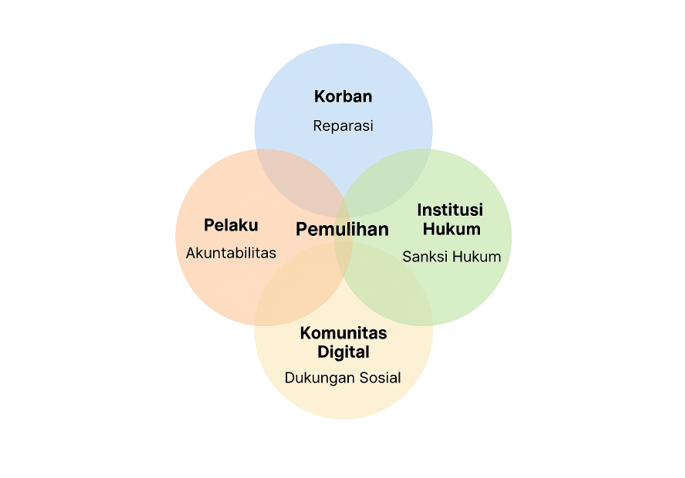
This study explores the development of a socio-legal framework for restorative justice (RJ) as an alternative approach to addressing online hate speech in Indonesia. In light of the increasing limitations of retributive legal systems—especially in digital contexts—this research investigates how RJ principles can be applied to digital conflict resolution involving victims, offenders, digital communities, and legal institutions. Using a qualitative descriptive design and a socio-legal lens, data were collected through semi-structured interviews, document analysis, and online observation. Findings reveal a substantial gap between formal punitive mechanisms and the social realities of online interaction. While legal actors tend to adopt retributive responses, digital communities have shown greater alignment with restorative practices, including public apologies, dialogue, and empathy.Four major themes rose to the fore: institutional resistance, psychosocial needs of the victims, grassroots initiatives for restorative justice, and the place of ethical technology in that regard. The most important outcome is an approved Socio-Legal Restorative Justice Digital Framework, which synergistically combines normative legal knowledge, community knowledge, and digital mediation tools. The framework theoretically and practically relates to a socio-juridical lexicon for promoting inclusive, participatory, and transformative justice in cyberspace, with an avenue for implementing and evolving adaptive policy in the future.
References
Braithwaite, J. (2021). Street-Level Meta-Strategies: Evidence on Restorative Justice and Responsive Regulation. Annual Review of Law and Social Science, 17, 205–225. https://doi.org/10.1146/annurev-lawsocsci-111720-013149
Carson, A., & Gibbons, A. (2023). The Big Chill? How Journalists and Sources Perceive and Respond to Fake News Laws in Indonesia and Singapore. Journalism Studies, 24(14), 1819–1838. https://doi.org/10.1080/1461670X.2023.2192299
Coe, P. (2022). The Draft Online Safety Bill and the regulation of hate speech: have we opened Pandora’s box? Journal of Media Law, 14(1), 50–75. https://doi.org/10.1080/17577632.2022.2083870
D’Souza, N., & Shapland, J. (2023). The exclusion of serious and organised offenders and their victims from the offer of restorative justice: Should this be so and what happens when the offer is put on the table? Criminology and Criminal Justice, 23(1), 60–77. https://doi.org/10.1177/17488958211021703
Egan, M. (2022). Remote justice: information rights as a tool of empowerment. International Review of Law, Computers & Technology, 36(2), 202–222. https://doi.org/10.1080/13600869.2022.2060465
Erdin, E., Shofiana, A., & Indar, I. J. (2025). The Effectiveness of Restorative Justice in Resolving Juvenile Criminal Offenses in Indonesia. Hakim: Jurnal Ilmu Hukum Dan Sosial, 3(1), 918–936. https://doi.org/10.51903/hakim.v3i1.2288
Erliyani, R. (2022). Examining Religious and Justice System in Indonesia to Prevent Cyberbullying. International Journal of Cyber Criminology, 15(2), 112–123. https://doi.org/10.5281/zenodo.4766548
Gaffney, H., Jolliffe, D., Eggins, E., Ferreira, J. G., Skinner, G., Ariel, B., & Strang, H. (2024). Protocol: The effect of restorative justice interventions for young people on offending and reoffending: A systematic review. Campbell Systematic Reviews, 20(2), e1403. https://doi.org/10.1002/cl2.1403
Garbe, L., Selvik, L. M., & Lemaire, P. (2021). How African countries respond to fake news and hate speech. Information, Communication & Society, 26(1), 86–103. https://doi.org/10.1080/1369118X.2021.1994623
Getahun, T. G. (2023). Countering online hate speech through legislative measures: The Ethiopian approach from a comparative perspective. The Communication Review, 26(3), 253–276. https://doi.org/10.1080/10714421.2023.2177487
Hidayah, A. R., Bajari, A., Hidayat, D. R., & Maryani, E. (2025). Shifting from Religious Populism to Authoritarian Populism: Two Decades of Identity Politics Dynamics in Indonesia. Social Sciences, 14(1), 45. https://doi.org/10.3390/socsci14010045
Kharisma, D., Pratiwi, B., & Handoko, S. (2024). Penerapan Restorative Justice dalam Kasus Kekerasan Domestik di Indonesia: Studi Empiris di Wilayah Perkotaan dan Pedesaan. Hakim: Jurnal Ilmu Hukum Dan Sosial, 2(4), 757–773. https://doi.org/10.51903/hakim.v2i4.2194
Kirkwood, S. (2022). A practice framework for restorative justice. Aggression and Violent Behavior, 63, 101688. https://doi.org/10.1016/j.avb.2021.101688
Kreiss, D., & McGregor, S. C. (2024). A review and provocation: On polarization and platforms. New Media and Society, 26(1), 556–579. https://doi.org/10.1177/14614448231161880
Laksito, J., Idris, M. F., & Waryanto, A. (2024). Hak dan Kewajiban Negara dalam Mengatasi Kejahatan Lintas Batas di Era Digital: Pendekatan Analisis Normatif. Hakim: Jurnal Ilmu Hukum Dan Sosial, 2(4), 774–790. https://doi.org/10.51903/hakim.v2i4.2154
Lodi, E., Perrella, L., Lepri, G. L., Scarpa, M. L., & Patrizi, P. (2021). Use of Restorative Justice and Restorative Practices at School: A Systematic Literature Review. International Journal of Environmental Research and Public Health, 19(1), 96. https://doi.org/10.3390/ijerph19010096
Lukum, A. F., & Hukumu, S. (2025). Perlindungan Hak Asasi Manusia dalam Penegakan Hukum: Studi Empiris terhadap Kasus Kriminalisasi Aktivis. Perkara : Jurnal Ilmu Hukum Dan Politik, 3(1), 712–730. https://doi.org/10.51903/perkara.v3i1.2342
Machmud, I. S., Ismail, D. E., & Puluhulawa, J. (2024). Efektivitas Konsep Restorative Justice Dalam Penanganan Kasus Penganiayaan Oleh Kejaksaan Negeri Bone Bolango. Hakim: Jurnal Ilmu Hukum Dan Sosial, 2(1), 157–185. https://doi.org/10.51903/hakim.v2i1.1542
Matás Castillo, M., Méndez, I., Esteban, C. R., & Soto, G. (2021). Restorative Justice Education from Intrajudicial Criminal Mediation Associated Factors. European Journal of Investigation in Health, Psychology and Education, 11(3), 627–638. https://doi.org/10.3390/ejihpe11030045
Polii, D. J., & Polii, V. (2025). Akses Keadilan bagi Kelompok Rentan: Studi Empiris Mengenai Hambatan Struktural dalam Sistem Peradilan. Perkara : Jurnal Ilmu Hukum Dan Politik, 3(1), 655–674. https://doi.org/10.51903/perkara.v3i1.2330
Ridwan Syaidi. (2025). Urgensi Penegakan Hukum Perlindungan Data Pribadi Terhadap Praktik Penahanan Ijazah Oleh Perusahaan: Studi Kasus di Surabaya. Jaksa : Jurnal Kajian Ilmu Hukum Dan Politik, 3(2), 13–24. https://doi.org/10.51903/jaksa.v3i2.2503
Sumartias, S., Pulubuhu, D. A. T., Elfitra, & Ratnasari, E. (2024). Portrait of Hate Speech Propagators’ Behaviour in Indonesia Twittersphere: A Comparative Virtual Ethnography Study. Jurnal Komunikasi: Malaysian Journal of Communication, 40(2), 1–22. https://doi.org/10.17576/JKMJC-2024-4002-01
Suzuki, M., & Yuan, X. (2021). How Does Restorative Justice Work? A Qualitative Metasynthesis. Criminal Justice and Behavior, 48(10), 1347–1365. https://doi.org/10.1177/0093854821994622
Windisch, S., Wiedlitzka, S., Olaghere, A., & Jenaway, E. (2022). Online interventions for reducing hate speech and cyberhate: A systematic review. Campbell Systematic Reviews, 18(2), e1243. https://doi.org/10.1002/cl2.1243
Zviyita, I., & Mare, A. (2024). Same threats, different platforms? Female journalists’ experiences of online gender-based violence in selected newsrooms in Namibia. Journalism, 25(4), 779–799. https://doi.org/10.1177/14648849231183815









3.png)