Personalization and Brand Visibility: A Key to Enhancing Customer Satisfaction in E-commerce
DOI:
https://doi.org/10.51903/ijgd.v3i1.2751Keywords:
personalization, brand visibility, customer satisfaction, e-commerce, digital strategyAbstract
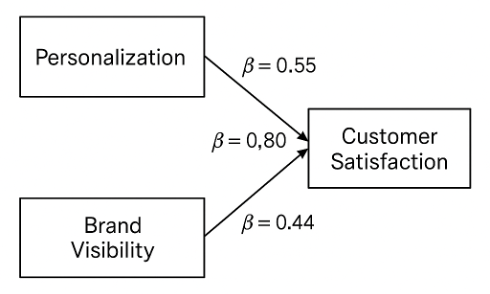
E-commerce has transformed consumer behavior by offering convenience, speed, and variety. In this evolving landscape, personalization and brand visibility have become essential strategies for businesses seeking to enhance customer satisfaction. This study investigates how these two factors influence customer satisfaction in the Indonesian e-commerce sector. Adopting a mixed-methods design, the research combines quantitative data from 400 online shoppers with qualitative insights from 20 in-depth interviews. Quantitative data were analyzed using regression analysis and structural equation modeling (SEM), while thematic analysis was employed for qualitative data to extract key patterns and experiences. The findings confirm that personalization—through tailored recommendations, customized interfaces, and targeted communications—positively affects customer satisfaction by increasing perceived relevance and engagement. Similarly, brand visibility—measured by the frequency and consistency of brand exposure across digital platforms—enhances trust and purchase intent. Notably, the study identifies a synergistic effect when personalization and brand visibility are integrated, resulting in up to a 40% increase in satisfaction scores compared to when these strategies are applied individually. Despite these positive outcomes, the study also highlights challenges, including privacy concerns, data management complexity, and market-specific limitations. This research contributes to digital marketing literature by offering a holistic understanding of how personalization and visibility jointly shape customer experiences. The findings provide practical implications for e-commerce businesses aiming to build loyalty and competitive advantage.
References
Adeoye-Olatunde, O. A., & Olenik, N. L. (2021). Research and Scholarly Methods: Semi-Structured Interviews. Journal of the American College of Clinical Pharmacy, 4(10), 1358–1367. https://doi.org/10.1002/jac5.1441
Al-Ebrahim, M. A., Bunian, S., & Nour, A. A. (2023). Recent Machine-Learning-Driven Developments in E-Commerce: Current Challenges and Future Perspectives. Engineered Science, 28(0), 1044. https://doi.org/10.30919/es1044
Alimamy, S., & Gnoth, J. (2022). I want it my way! The Effect of Perceptions of Personalization through Augmented Reality and Online Shopping on Customer Intentions to Co-Create Value. Computers in Human Behavior, 128, 107105. https://doi.org/10.1016/j.chb.2021.107105
Alrumiah, S. S., & Hadwan, M. (2021). Implementing Big Data Analytics in E-Commerce: Vendor and Customer View. IEEE Access, 9, 37281–37286. https://doi.org/10.1109/access.2021.3063615
Ameen, N., Tarhini, A., Reppel, A., & Anand, A. (2021). Customer Experiences in the Age of Artificial Intelligence. Computers in Human Behavior, 114, 106548. https://doi.org/10.1016/j.chb.2020.106548
Bawack, R. E., Bonhoure, E., Kamdjoug, J. R. K., & Giannakis, M. (2023). How Social Media Live Streams Affect Online Buyers: A Uses and Gratifications Perspective. International Journal of Information Management, 70, 102621. https://doi.org/10.1016/j.ijinfomgt.2023.102621
Braun, V., & Clarke, V. (2021). Can I use TA? Should I use TA? Should I not use TA? Comparing Reflexive Thematic Analysis and Other Pattern-Based Qualitative Analytic Approaches. Counselling and Psychotherapy Research, 21(1), 37–47. https://doi.org/10.1002/capr.12360
Cheung, G. W., Cooper-Thomas, H. D., Lau, R. S., & Wang, L. C. (2024). Reporting Reliability, Convergent and Discriminant Validity with Structural Equation Modeling: A Review and Best-Practice Recommendations. Asia Pacific Journal of Management, 41(2), 745–783. https://doi.org/10.1007/s10490-023-09871-y
Chiu, M. C., & Chuang, K. H. (2021). Applying Transfer Learning to Achieve Precision Marketing in An Omni-Channel System – A Case Study of a Sharing Kitchen Platform. International Journal of Production Research, 59(24), 7594–7609. https://doi.org/10.1080/00207543.2020.1868595
Dash, G., & Paul, J. (2021). CB-SEM vs PLS-SEM Methods for Research in Social Sciences and Technology Forecasting. Technological Forecasting and Social Change, 173, 121092. https://doi.org/10.1016/j.techfore.2021.121092
Farhad, M. A. (2024). Consumer data Protection Laws and Their Impact on Business Models in the Tech Industry. Telecommunications Policy, 48(9), 102836. https://doi.org/10.1016/j.telpol.2024.102836
Go, E. M., & Mothelsang, K. (2024). Trends in Modern Typography Design: Visual Preferences on E-Commerce Platforms. International Journal of Graphic Design, 2(2), 248–263. https://doi.org/10.51903/ijgd.v2i2.2147
Grandhi, B., Patwa, N., & Saleem, K. (2021). Data-Driven Marketing for Growth and Profitability. EuroMed Journal of Business, 16(4), 381–398. https://doi.org/10.1108/emjb-09-2018-0054
Hajdas, M., Radomska, J., & Silva, S. C. (2022). The Omni-Channel Approach: A Utopia for Companies? Journal of Retailing and Consumer Services, 65, 102131. https://doi.org/10.1016/j.jretconser.2020.102131
Haugeland, I. K. F., Følstad, A., Taylor, C., & Alexander, C. (2022). Understanding the User Experience of Customer Service Chatbots: An Experimental Study of Chatbot Interaction Design. International Journal of Human-Computer Studies, 161, 102788. https://doi.org/10.1016/j.ijhcs.2022.102788
Hidayat, M. S., Muhammad, W., & Isdayanti, P. L. (2025). Digital Marketing Ethics in the Age of AI: A Comparative Analysis of Transparency and Consumer Trust in E-Commerce Platforms. Journal of Management and Informatics, 4(1), 723–740. https://doi.org/10.51903/jmi.v4i1.178
Karimian, Z., & Chahartangi, F. (2024). Development and Validation of a Questionnaire to Measure Educational Agility: A Psychometric Assessment Using Exploratory Factor Analysis. BMC Medical Education, 24(1), 1284. https://doi.org/10.1186/s12909-024-06307-z
Khoa, B. T., Hung, B. P., & Hejsalem-Brahmi, M. (2023). Qualitative Research in Social Sciences: Data Collection, Data Analysis and Report Writing. International Journal of Public Sector Performance Management, 12(1–2), 187–209. https://doi.org/10.1504/ijpspm.2023.132247
Lambillotte, L., Magrofuoco, N., Poncin, I., & Vanderdonckt, J. (2022). Enhancing Playful Customer Experience with Personalization. Journal of Retailing and Consumer Services, 68, 103017. https://doi.org/10.1016/j.jretconser.2022.103017
Liao, S. H., Hu, D. C., Chung, Y. C., & Huang, A. P. (2021). Risk and Opportunity for Online Purchase Intention – A Moderated Mediation Model Investigation. Telematics and Informatics, 62, 101621. https://doi.org/10.1016/j.tele.2021.101621
Miao, M., Jalees, T., Zaman, S. I., Khan, S., Hanif, N. ul A., & Javed, M. K. (2022). The Influence of E-Customer Satisfaction, E-Trust and Perceived Value on Consumer’s Repurchase Intention in B2C E-Commerce Segment. Asia Pacific Journal of Marketing and Logistics, 34(10), 2184–2206. https://doi.org/10.1108/apjml-03-2021-0221
Nadeem, W., Tan, T. M., Tajvidi, M., & Hajli, N. (2021). How do experiences enhance brand relationship performance and value co-creation in social commerce? The role of consumer engagement and self brand-connection. Technological Forecasting and Social Change, 171, 120952. https://doi.org/10.1016/J.TECHFORE.2021.120952
Nur, D., Ahmad, F., Zubaedah, A., Hafizi, R., Umam, F. C., & Judijanto, L. (2024). Pakistan Journal of Life and Social Sciences The Evolution of Data Privacy Laws: Balancing Technological Innovation and Human Rights in the Age of Big Data. Pak. j. Life Soc. Sci, 22(2), 18490–18500. https://doi.org/10.57239/pjlss-2024-22.2.001354
Osemeke, R. F., Igabari, J. N., & Christian, N. D. (2024). Detection and correction of violations of linear model assumptions by means of residuals. Journal of Science Innovation and Technology Research, 3(9), 139. https://africanscholarpub.com/ajsitr/article/view/139
Owusu-Mensah, D., Sarfo, P. A., & Kusi, G. A. (2025). Exploring the Impact of Artificial Intelligence on Customer Experience Personalization and Marketing Strategy Optimization in Digital Marketing: An Empirical Analysis. Journal of Management and Informatics, 4(2), 822–843. https://doi.org/10.51903/jmi.v4i2.242
Riegger, A. S., Klein, J. F., Merfeld, K., & Henkel, S. (2021). Technology-Enabled Personalization in Retail Stores: Understanding Drivers and Barriers. Journal of Business Research, 123, 140–155. https://doi.org/10.1016/j.jbusres.2020.09.039
Riegger, A. S., Merfeld, K., Klein, J. F., & Henkel, S. (2022). Technology-Enabled Personalization: Impact of Smart Technology Choice on Consumer Shopping Behavior. Technological Forecasting and Social Change, 181, 121752. https://doi.org/10.1016/j.techfore.2022.121752
Rosadi, S. D., Noviandika, A., Walters, R., & Aisy, F. R. (2023). Indonesia’s Personal Data Protection Bill, 2020: Does it Meet the Needs of the New Digital Economy? International Review of Law, Computers & Technology, 37(1), 78–90. https://doi.org/10.1080/13600869.2022.2114660
Rosyida, H. F., Syafei, A., & Nuha, M. U. (2025). The Evolving Field of Graphic Design: Challenges and Opportunities in the Integration of Artificial Intelligence. International Journal of Graphic Design, 3(1), 19–38. https://doi.org/10.51903/ijgd.v3i1.2537
Russo, D., & Stol, K. J. (2021). PLS-SEM for Software Engineering Research. ACM Computing Surveys (CSUR), 54(4). https://doi.org/10.1145/3447580
Prihatmoko, S., & Setiyadi, T. (2024). Enhancing Public Awareness of the Designer Profession: Visual Communication Strategies in Instagram Campaigns. International Journal of Graphic Design, 2(2), 179–194. https://doi.org/10.51903/ijgd.v2i2.2113
Sakas, D. P., Reklitis, D. P., Terzi, M. C., & Vassilakis, C. (2022). Multichannel Digital Marketing Optimizations through Big Data Analytics in the Tourism and Hospitality Industry. Journal of Theoretical and Applied Electronic Commerce Research 2022, Vol. 17, Pages 1383-1408, 17(4), 1383–1408. https://doi.org/10.3390/jtaer17040070
Saranya, K. N., Bhandari, M., Borad, N., Reddy, P. V. P., & Kumar, S. (2025). Surveying the Impact of Rarely Investigated Design Components on User Engagement. International Journal of Graphic Design, 3(1), 39–52. https://doi.org/10.51903/ijgd.v3i1.2752
Shankar, V., Grewal, D., Sunder, S., Fossen, B., Peters, K., & Agarwal, A. (2022). Digital Marketing Communication in Global Marketplaces: A Review of Extant Research, Future Directions, and Potential Approaches. International Journal of Research in Marketing, 39(2), 541–565. https://doi.org/10.1016/j.ijresmar.2021.09.005
Shet, S. V., Poddar, T., Wamba Samuel, F., & Dwivedi, Y. K. (2021). Examining the Determinants of Successful Adoption of Data Analytics in Human Resource Management – A Framework for Implications. Journal of Business Research, 131, 311–326. https://doi.org/10.1016/j.jbusres.2021.03.054
Stamenkov, G. (2023). Recommendations for Improving Research Quality: Relationships Among Constructs, Verbs in Hypotheses, Theoretical Perspectives, and Triangulation. Quality and Quantity, 57(3), 2923–2946. https://doi.org/10.1007/s11135-022-01461-2
Stantcheva, S. (2023). How To Run Surveys: A Guide to Creating Your Own Identifying Variation and Revealing The Invisible. Annual Review of Economics, 15, 205–234. https://doi.org/10.1146/annurev-economics-091622-010157
Sudina, E. (2021). Study and Scale Quality in Second Language Survey Research, 2009–2019: The Case of Anxiety and Motivation. Language Learning, 71(4), 1149–1193. https://doi.org/10.1111/lang.12468
Susanto, E., & Khaq, Z. D. (2024). Enhancing Customer Service Efficiency in Start-Ups with AI: A Focus on Personalization and Cost Reduction. Journal of Management and Informatics, 3(2), 267–281. https://doi.org/10.51903/jmi.v3i2.34
Taufiq-Hail, A. M., Yusof, S. A. B. M., Al Shamsi, I. R. H., Bino, E., Saleem, M., Mahmood, M., & Kamran, H. (2023). Investigating the Impact of Customer Satisfaction, Trust, and Quality of Services on the Acceptance of Delivery Services Companies and Related Applications in Omani Context: A Predictive Model Assessment Using PLSpredict. Cogent Business & Management, 10(2). https://doi.org/10.1080/23311975.2023.2224173
Timoumi, A., Gangwar, M., & Mantrala, M. K. (2022). Cross-Channel Effects of Omnichannel Retail Marketing Strategies: A Review of Extant Data-Driven Research. Journal of Retailing, 98(1), 133–151. https://doi.org/10.1016/j.jretai.2022.02.008
Tran, V. D., & Nguyen, N. T. T. (2022). Investigating the Relationship Between Brand Experience, Brand Authenticity, Brand Equity, and Customer Satisfaction: Evidence from Vietnam. Cogent Business & Management, 9(1). https://doi.org/10.1080/23311975.2022.2084968
Vivek, R., & Nanthagopan, Y. (2021). Review and Comparison of MultiMethod and Mixed Method Application in Research Studies. European Journal of Management Issues, 29(4), 200–208.
Wang, D., Luo, X. (Robert), Hua, Y., & Benitez, J. (2023). Customers’ Help-Seeking Propensity and Decisions in Brands’ Self-Built Live Streaming E-Commerce: A Mixed-Methods and fsQCA Investigation from a Dual-Process Perspective. Journal of Business Research, 156, 113540. https://doi.org/10.1016/j.jbusres.2022.113540
Winter, S., Maslowska, E., & Vos, A. L. (2021). The Effects of Trait-Based Personalization in Social Media Advertising. Computers in Human Behavior, 114, 106525. https://doi.org/10.1016/j.chb.2020.106525
Wu, Y., Nambisan, S., Xiao, J., & Xie, K. (2022). Consumer Resource Integration and Service Innovation in Social Commerce: The Role of Social Media Influencers. Journal of the Academy of Marketing Science, 50(3), 429–459. https://doi.org/10.1007/s11747-022-00837-y
Zickar, M. J., & Keith, M. G. (2023). Innovations In Sampling: Improving The Appropriateness And Quality Of Samples In Organizational Research. Annual Review of Organizational Psychology and Organizational Behavior, 10, 315–337. https://doi.org/10.1146/annurev-orgpsych-120920-052946
Zyphur, M. J., Bonner, C. V., & Tay, L. (2023). Structural Equation Modeling in Organizational Research: The State of Our Science And Some Proposals for Its Future. Annual Review of Organizational Psychology and Organizational Behavior, 10, 495–517. https://doi.org/10.1146/annurev-orgpsych-041621-031401
Downloads
Published
Issue
Section
License
Copyright (c) 2025 Ika Adi Ariani, Fachrur Rozi, Amin Muhammad, Eka Dwi Safitri

This work is licensed under a Creative Commons Attribution-ShareAlike 4.0 International License.











5.png)